
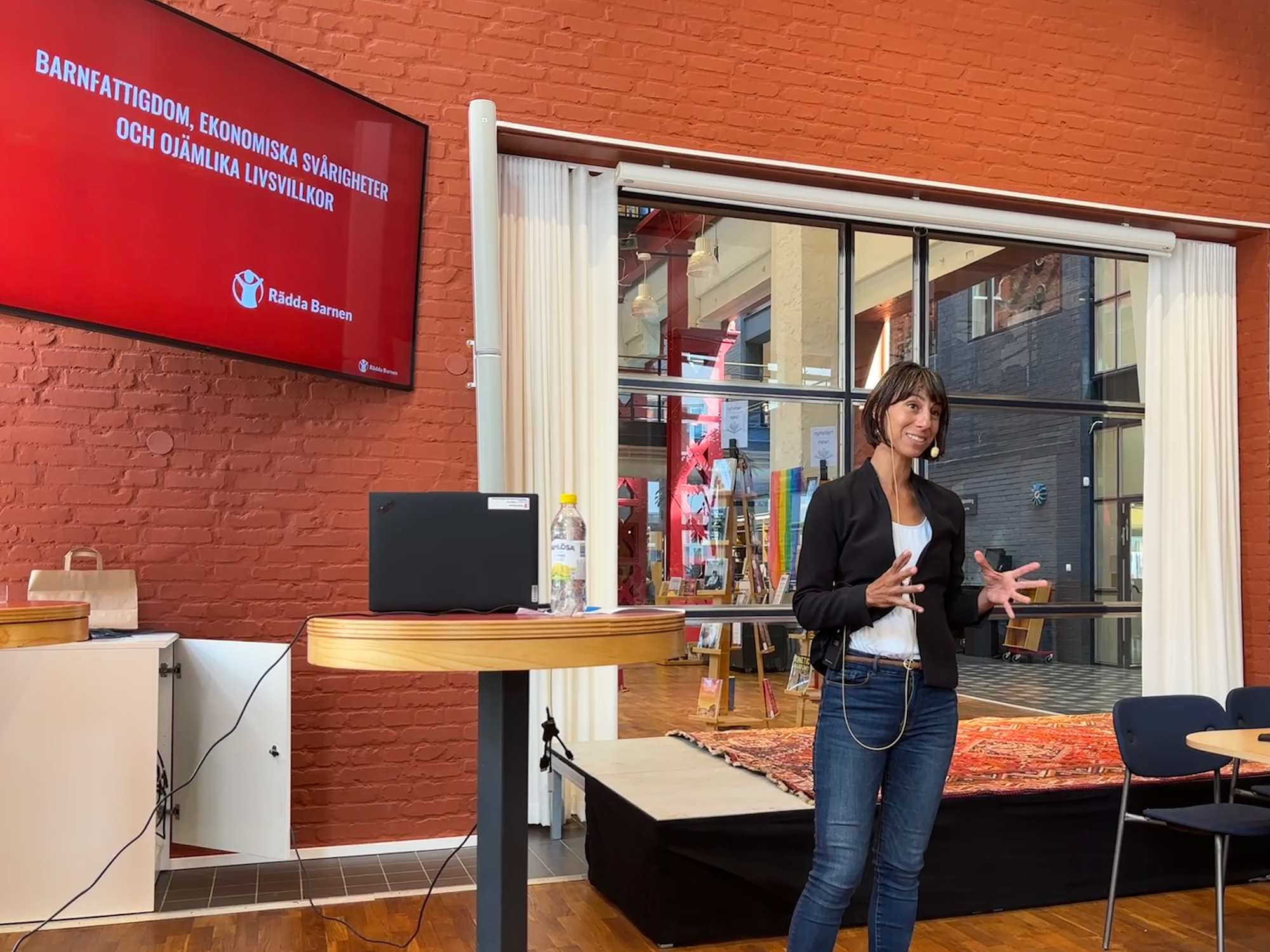
Samira Abutaleb Rosenlundh, outlined the main points of the Child Poverty Report.
Understanding child poverty in Sweden and Jönköping
What is the current situation regarding child poverty, and what can be done to ensure more children have a secure upbringing? This was the focus when Save the Children in Jönköping and the School of Health and Welfare at Jönköping University (JU) organized an open discussion on 20 August, where the latest report on child poverty was presented and discussed by local politicians.
Samira Abutaleb Rosenlundh, adviser at Save the Children, outlined the main points of the Child Poverty Report 2025. It is based on children’s right to an adequate standard of living under the UN Convention on the Rights of the Child (UNCRC) and shows that around 276,000 children in Sweden live in economic vulnerability. Samira Abutaleb Rosenlundh particularly emphasized how a family’s financial situation affects children’s opportunities to participate in society on equal terms.
“A family’s financial situation directly affects a child’s opportunities to participate in society, engage in meaningful leisure activities, and be part of social communities. Investing in children is therefore not just a matter of children’s rights, but also an investment in a sustainable society for all. It is, moreover, a principle of children’s rights and a legal responsibility, not merely a political or rhetorical issue,” said Samira Abutaleb Rosenlundh.
Differences within Jönköping
During the afternoon, statistics on the situation in Jönköping municipality were also presented. Child poverty varies between different neighbourhoods and is highest in areas such as Råslätt, Österängen and Öxnehaga. The report also shows that economic vulnerability varies depending on a family’s background and that integration into the labour market is a key factor behind these differences.
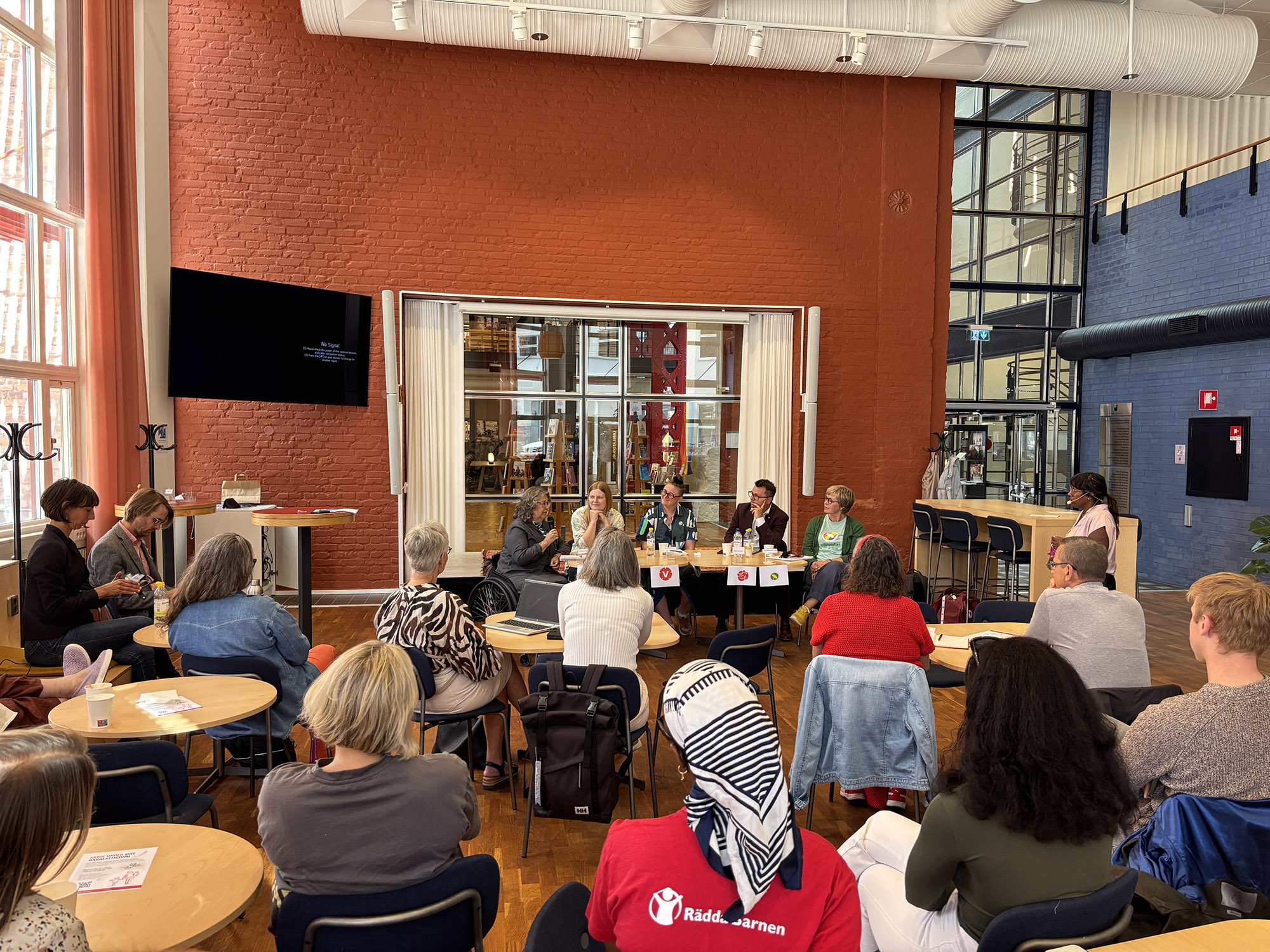
Political discussion moderated by Frida Lygnegård.
Politicians discussed possible solutions
The presentation was followed by a political discussion moderated by Frida Lygnegård, researcher specializing in children and young people, and also Research Environment Manager at the School of Health and Welfare. The participating political parties discussed possible measures to reduce child poverty. Issues such as the role of schools, free leisure activities, public transport, and the importance of community organizations for children’s participation took centre stage.
“I am delighted with today’s lecture and with the opportunity, together with Save the Children, to highlight the issue of child poverty, which fundamentally concerns children’s living conditions, health, and hope for the future. By bringing together researchers, civil society, and political representatives, we are creating a forum where knowledge, children’s rights, and political decisions can come together,” said Frida Lygnegård.
All political parties had been invited to take part; those participating in the debate were Andreas Persson, Socialdemokraterna (the Social Democratic Party), Malin Skreding-Hallgren, Miljöpartiet (the Green Party), Julia Martinsson-Löf, Vänsterpartiet (the Left Party), Lise-Lotte Finell, Centerpartiet (the Centre Party), och Martina Axene, Kristdemokraterna (the Christian Democrats).
The 2025 Child Poverty Report is available on Save the Children’s website.


